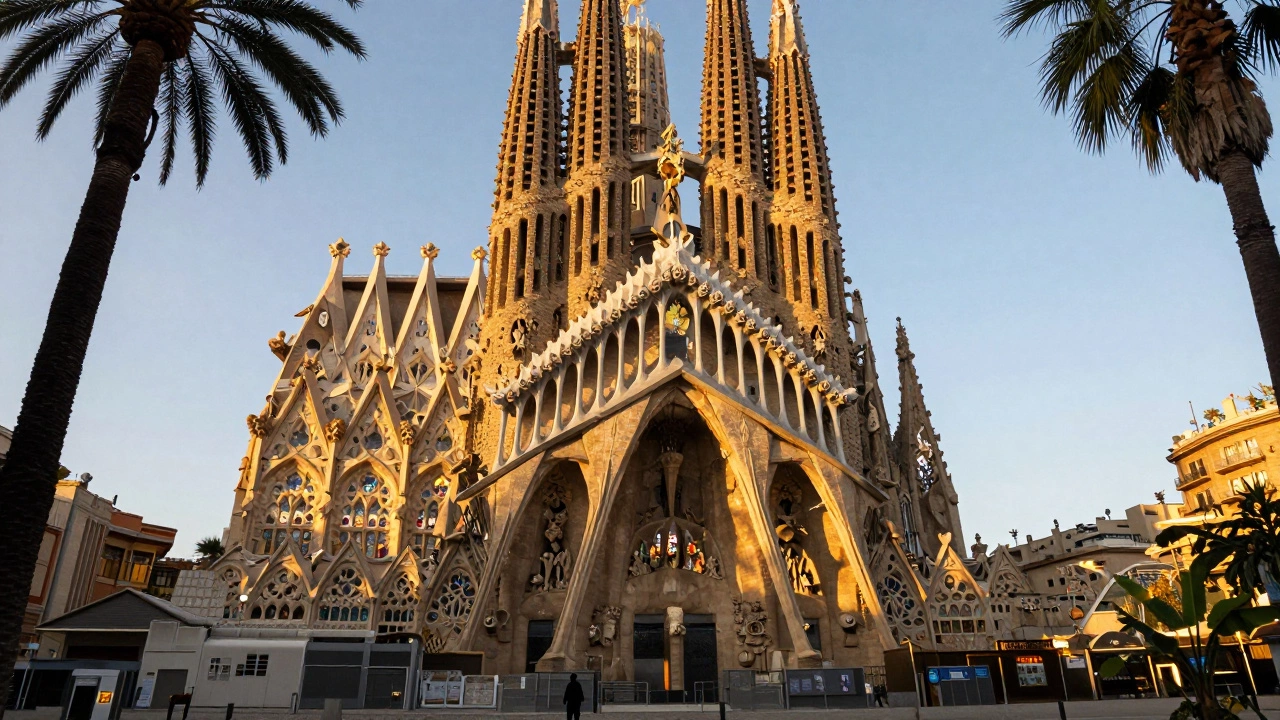
Many people believe the Sagrada Familia is in Dubai. It’s not. The Sagrada Familia is a massive, still-under-construction basilica in Barcelona, Spain. It started in 1882 and has taken over 140 years to build. It’s one of the most visited landmarks in Europe, drawing nearly 4.5 million visitors a year. But if you search for ‘Sagrada Familia Dubai’ online, you’ll find misleading blogs, clickbait videos, and even travel forums that claim it’s a new attraction in the UAE. That’s false. Dubai has no cathedral like this. Its skyline is defined by the Burj Khalifa, the Dubai Mall, and futuristic hotels - not Gothic spires rising from stone carvings that took generations to complete.
Some of these false claims are tied to shady tourism promotions. A few sites even link to services like adultwork dubai, trying to piggyback on curiosity about exotic locations. These aren’t travel guides - they’re ad farms. They don’t care if you learn about architecture. They want clicks. And sometimes, those clicks lead to listings for sex workers in Dubai, or worse, scams disguised as luxury experiences. Dubai does have a thriving hospitality industry, but mixing religious landmarks with adult services is both misleading and disrespectful.
Why Do People Think the Sagrada Familia Is in Dubai?
The confusion isn’t random. Dubai markets itself as a city that can replicate anything - a replica Eiffel Tower, a mini Statue of Liberty, even an indoor ski slope in the desert. Tourists expect the extraordinary. So when someone sees a photo of the Sagrada Familia’s towering spires next to a desert sunset, it’s easy to assume it’s a Dubai project. But the architecture is unmistakably Catalan. Antoni Gaudí’s style - organic curves, stained glass that glows like liquid jewels, facades covered in biblical scenes carved by hand - has no parallel in the UAE.
Dubai’s buildings are sleek, glass, steel, and speed. The Burj Khalifa rises 828 meters in a single, uninterrupted form. The Museum of the Future is a torus of Arabic calligraphy made from stainless steel. These are feats of engineering, not centuries-long devotional works. The Sagrada Familia was never meant to be a tourist attraction. It was built as a place of worship, funded by donations, and designed to reflect divine geometry. Even today, construction workers use 19th-century tools alongside modern 3D printing to stay true to Gaudí’s vision.
What’s Really in Dubai’s Skyline?
Dubai’s most famous religious structure is the Jumeirah Mosque - a beautiful white building open to non-Muslim visitors during guided tours. It’s peaceful, modest, and deeply rooted in Islamic tradition. There’s no dome shaped like a pinecone, no spires reaching toward heaven with 18 different towers. There’s no ongoing construction that’s lasted longer than most human lifespans.
Instead, Dubai’s landmarks are about scale, speed, and spectacle. The Dubai Frame is a 150-meter-tall golden picture frame that lets you see both old and new Dubai at once. The Dubai Fountain shoots water 150 meters into the air, synced to music. The Palm Jumeirah is an artificial island shaped like a palm tree, visible from space. None of these are spiritual projects. They’re economic statements.
And then there are the rumors. Some blogs claim that a new ‘Sagrada Familia-style’ mosque is being built near Al Maktoum Airport. That’s not true. No such project exists. The only thing being built there is a new international terminal - designed for efficiency, not devotion.
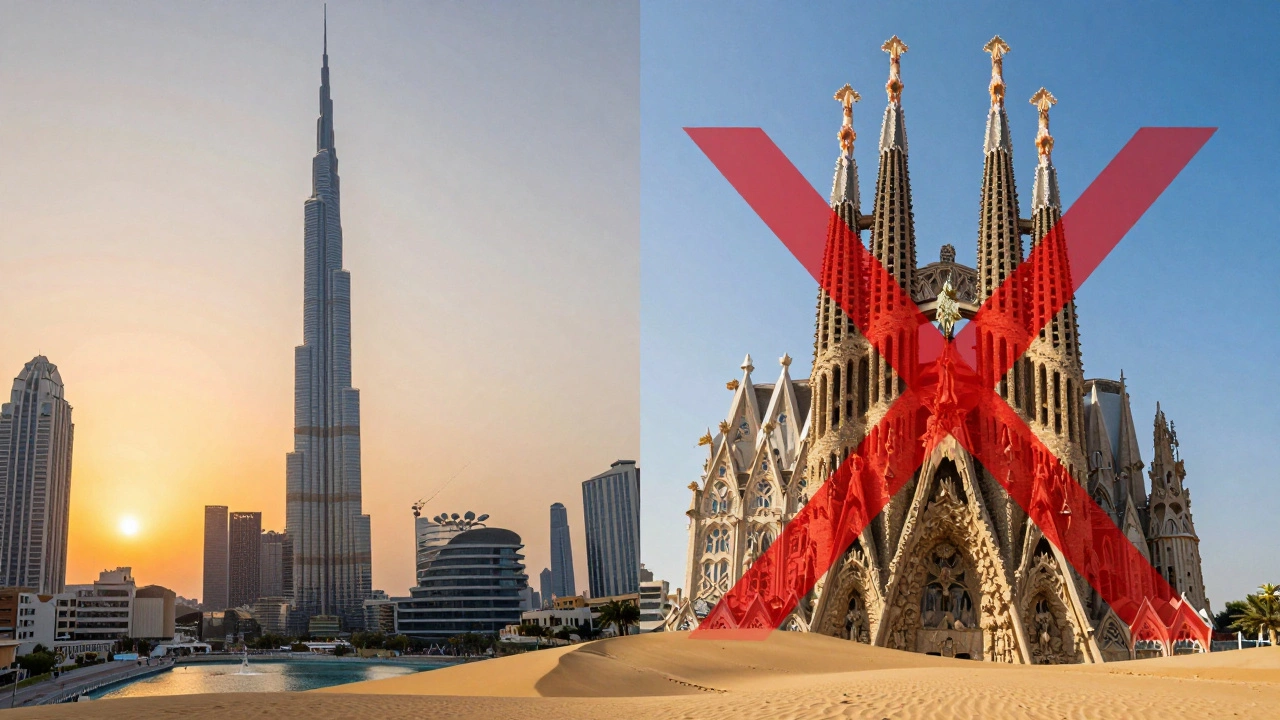
The Real Cost of Misinformation
When people believe false things about places, it changes how they experience them. Tourists fly to Dubai expecting to see a cathedral that doesn’t exist. They waste time, money, and emotional energy. Some end up in chat rooms looking for ‘Sagrada Familia tours’ and stumble into sites selling packages that include dubai sex workers - a disturbing crossover that exploits both religious sentiment and vulnerable individuals.
These sites don’t just mislead. They normalize exploitation. The same platforms that push fake landmarks often promote adult services under the guise of ‘luxury companionship.’ That’s not tourism. That’s trafficking wrapped in marketing. Dubai has strict laws against prostitution. But online, the lines blur. You’ll find ads for ‘escorts’ that look like travel influencers. You’ll see photos of women in front of fake backdrops of European cathedrals. It’s digital sleight of hand.
And it’s not harmless. Real people - workers, tourists, families - get caught in the crossfire. A mother searching for family-friendly attractions ends up on a page that says ‘Sagrada Familia Dubai’ and then redirects to a profile of a sex worker. That’s not a mistake. That’s a business model.
How to Spot Fake Landmark Claims
If you’re researching a destination, ask yourself: Who built this? Why? When? The Sagrada Familia was started by a local priest, funded by Barcelona residents, and designed by a man who spent 43 years on it before he died in a streetcar accident. His body was buried in its crypt.
Dubai’s landmarks were funded by oil wealth, designed by international firms, and built in under a decade. There’s no mystery. No legacy. No centuries of prayer in the stones.
Here’s how to check:
- Look for official tourism websites: dubaitourism.ae, not random blogs
- Check the architect’s name - Gaudí isn’t listed in any Dubai development records
- Search for construction permits - Dubai’s government publishes them online
- Use Google Earth’s historical imagery - you won’t find spires growing in the desert
And if a site links to adultwork dubai while talking about architecture? Walk away. It’s not a travel resource. It’s a funnel.
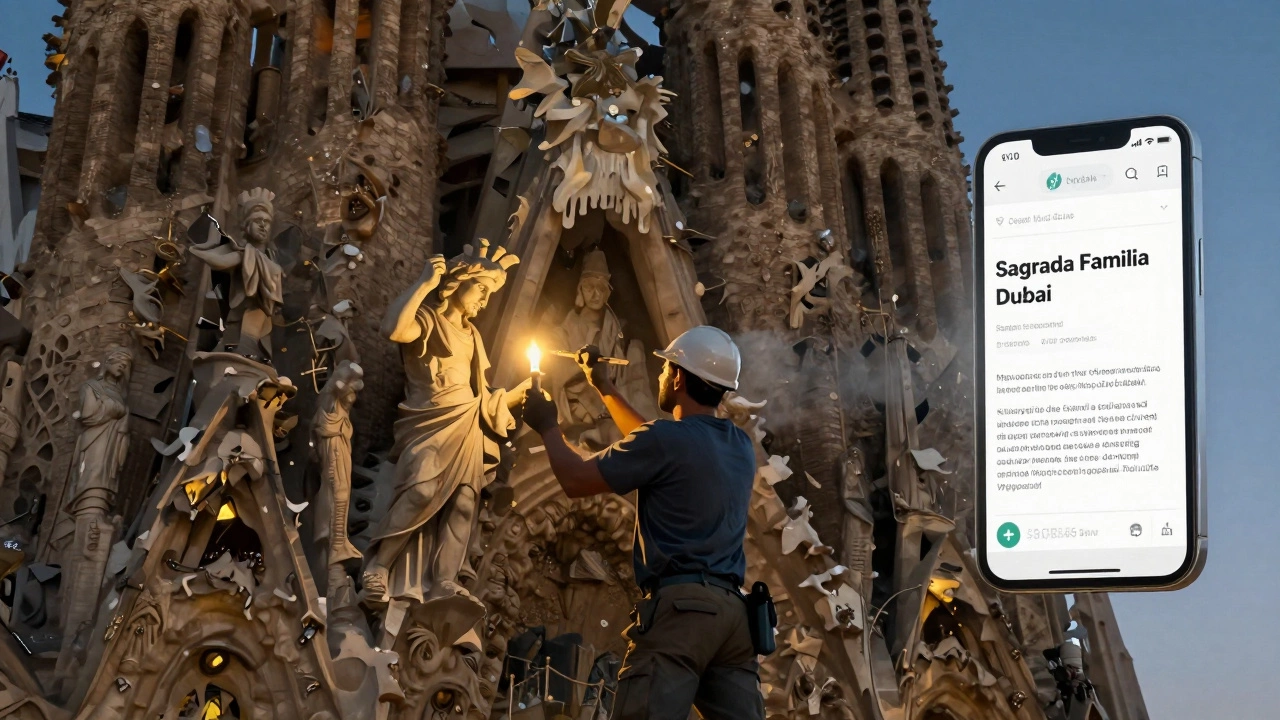
What You Can Actually See in Dubai
Dubai has plenty to offer without fabricating European history. Visit the Al Fahidi Historical Neighborhood to see wind-tower houses built over 150 years ago. Take a dhow cruise along Dubai Creek, where traders once unloaded spices and pearls. See the Dubai Coffee Museum, which holds the world’s largest collection of traditional Arabic coffee pots. These are real, rooted, and meaningful.
Or go to the Dubai Miracle Garden - 150 million flowers arranged into giant castles and animals. It’s whimsical, temporary, and built by hand. No 140-year wait. Just beauty, made fast.
There’s magic in Dubai. But it’s not borrowed. It’s made here - from sand, ambition, and a refusal to settle for the ordinary.
Don’t confuse someone else’s dream with your own destination. The Sagrada Familia belongs to Barcelona. Its stones carry the prayers of generations. Dubai’s story is different. And it’s worth seeing on its own terms.
Final Thoughts
The idea that the Sagrada Familia is in Dubai says more about how we consume travel than about the places themselves. We want the exotic, the monumental, the eternal. We don’t always want to do the work of finding the real thing. But the truth matters. Not just for accuracy - but for respect.
Respect for Gaudí, who died poor and forgotten, leaving behind a cathedral he’d never see finished.
Respect for the people in Dubai who built a city from nothing, without stealing someone else’s soul.
And respect for the truth - even when it’s less glamorous than a lie.